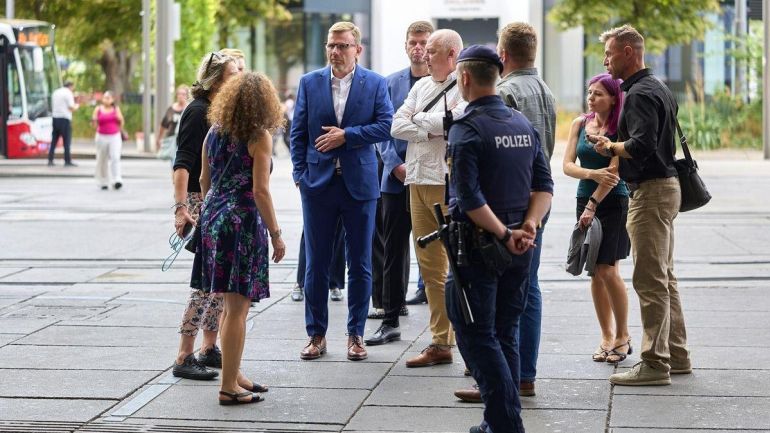


In Vienna, no-alcohol and no-weapons zones have proven to be successful public safety measures that also help to reduce noise in the area. Brno is now considering similar measures. On 1 September, a Czech delegation therefore visited the Austrian capital to learn about the legal basis and the practical experience of the Vienna Provincial Police Directorate.
Brno wants to tackle the increased noise and littering associated with alcohol consumption in public. Vienna had previously experienced similar problems, including the harassment of passers-by. In order to introduce no-alcohol zones, reports of such incidents and relevant statistics were first documented by the Vienna Provincial Police Directorate, Austria's national railway operator (ÖBB), and Vienna's public transport provider (Wiener Linien). The aim of the measures is to maintain public order rather than to address alcohol abuse as a public health issue.
Lessons from Vienna
The first no-alcohol and no-weapons zone in Vienna was established around Praterstern station in 2018. Further no-weapons zones have since been established around Yppenplatz square and a no-alcohol zone was established around the Westbahnhof station. The no-weapons zone in Vienna's 10th district, Favoriten, was also presented as an example. They were established due to an increase in violent offences involving knives, particularly among young people. The police in the 21st district also presented positive results from the alcohol ban introduced at Floridsdorf station in February 2025. The number of reported offences peaked in the summer of 2025 at up to ten per day but has since fallen to an average of around 0.5 per day.
Legal background
As explained by the Department for Inspection of Business Establishments, Fire Prevention and Events during the expert discussion, in cases of serious problems, Austrian local authorities may issue local police regulations within their area of responsibility. Such regulations must not contravene applicable law and can be implemented within a few weeks. Following the introduction of the alcohol ban at Praterstern station, the public was fully informed about the measure. The authorities carried out systematic checks, issued fines, filed reports and seized alcoholic drinks. No-weapons zones and safety zones, on the other hand, are regulated by the Security Police Act.
Safety zones are measures of last resort where people, especially minors, are at risk and alternatives such as CCTV surveillance or a police presence are insufficient. A prerequisite for establishing a safety zone is a corresponding situation report from the responsible police station. If there are specific indications that an individual poses a risk, such as repeated criminal offences, they may be prohibited from entering an area within a radius of up to 150 metres. However, potential challenges associated with safety zones have also been highlighted. These include displacement effects, the demarcation of zone boundaries, and issues of jurisdiction between different police stations. No-weapons zones may be established in areas where dangerous attacks on people or property are expected. Such zones are established based on a situation report and remain in force for three months at a time.
Further information
- No-weapons and safety zones at Yppenplatz square - City of Vienna (German)
- Following interim assessment, alcohol ban at Franz-Jonas-Platz square remains in place - City of Vienna (German)