5.4 Anergy network start-up cells – ÖGUT

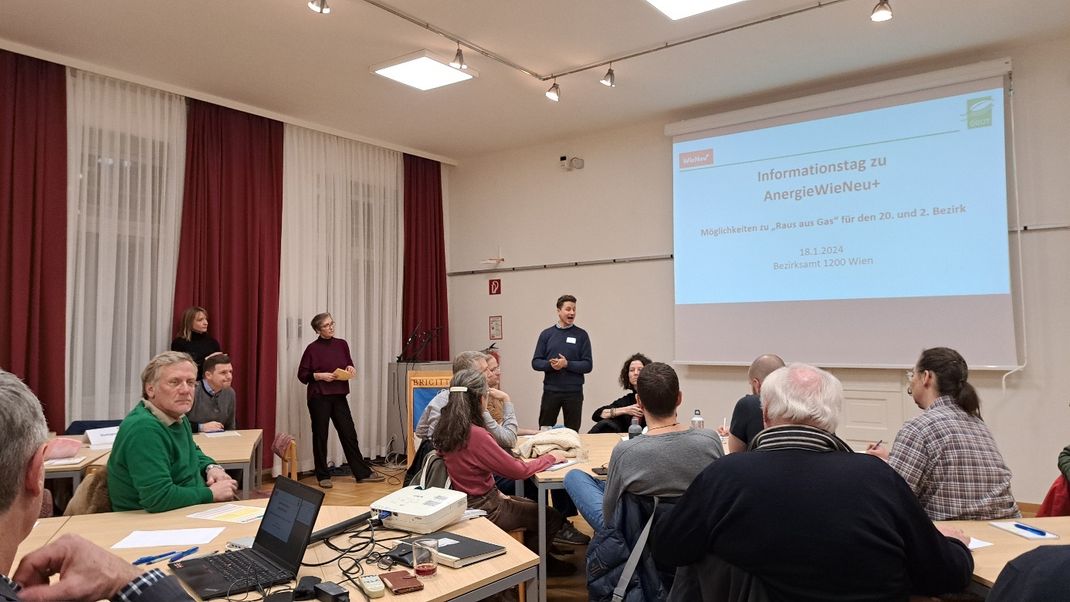
The Austrian Society for Environment and Technology (ÖGUT) assessed nine blocks of residential buildings with regard to their suitability for the installation of anergy networks. Anergy networks are an innovative alternative which to date have only been road-tested in a few isolated cases in Vienna. They involve multiple buildings sharing heat harvested from ambient environmental sources, i.e. low-temperature thermal energy from the ground, groundwater or the surrounding air. This energy is then warmed or cooled to the required temperature using heat pumps.
Where individual solutions are technically difficult to implement due to lack of space, anergy networks serving multiple properties are a good and viable alternative. Their major advantage lies in the use of thermal energy at constant temperatures from the ground, groundwater or the surrounding air. This ensures a particularly efficient energy supply, both in hot summers as well as in very cold winters.
To start with, eleven potential start-up cells were identified within the programme area and evaluated in a multi-phase process. Decisive criteria included distance from the existing district heating grid and the structural and legal status quo. After close consultation with property owners and other stakeholders, three blocks of residential buildings were selected on account of their especially high potential:
- Kluckygasse,
- Gaußplatz South and
- Gaußplatz Northeast.
Alongside the technical analysis, the focus was on working with the property owners to successfully overcome obstacles such as majority decision-making, commonhold ownership structures and varying states of refurbishment. The project drafted recommendations for successful initiation and management of anergy network start-up cells and documented the findings as a set of guidelines for future projects.
Takeaways & challenges
The Vienna Heating Plan clearly designates zones for expansion of the central district heating grid and zones for local, decentralised heating networks ("Local collective heating" category).
Anergy projects are also eligible for subsidies, even in zones that can theoretically be connected to the central district heating grid, and this is an important incentive for innovative solutions.
Long-term planning is crucially important: decarbonisation of existing buildings calls for timely conversion concepts aligned with construction cycles and energy demand patterns.
External guidance from experienced consultants is crucially important, to provide property owners with professional advice and support from idea through to conclusion of the contract.
Projects like this require a permanent "facilitator" of some kind, i.e. someone to provide ongoing moderation, network-building and support over a period of several years.
Decision-making processes in commonhold associations are often protracted and subject to conflict. Without neutral external moderation or mediation, they frequently grind to a halt.
The high level of information required at the start and the subsequent realisation of the need to take action often lead to a slump in motivation.
A "first mover advantage" or staggered funding models could be used to reward those who act as start-up cells.
Property management companies are key actors: however, they must be specifically contracted to perform these tasks as they are not part of their usual administrative remit. Educational sessions and outreach events – e.g. by ÖVI (property sector training institute) or Hauskunft (the City of Vienna's renovation advice centre) – are important kick-off activities.
Model solutions, practical guides and/or recommendations – e.g. a practice-based "10 Step Plan" for anergy network projects – could go a long way towards eliminating the initial hurdles.
This project was supported with funding from the "Grätzlförderung" scheme.
Project partners
- Austrian Society for Environment and Technology (ÖGUT)