5.3 Modernisation of building utilities: Ybbsstraße 6

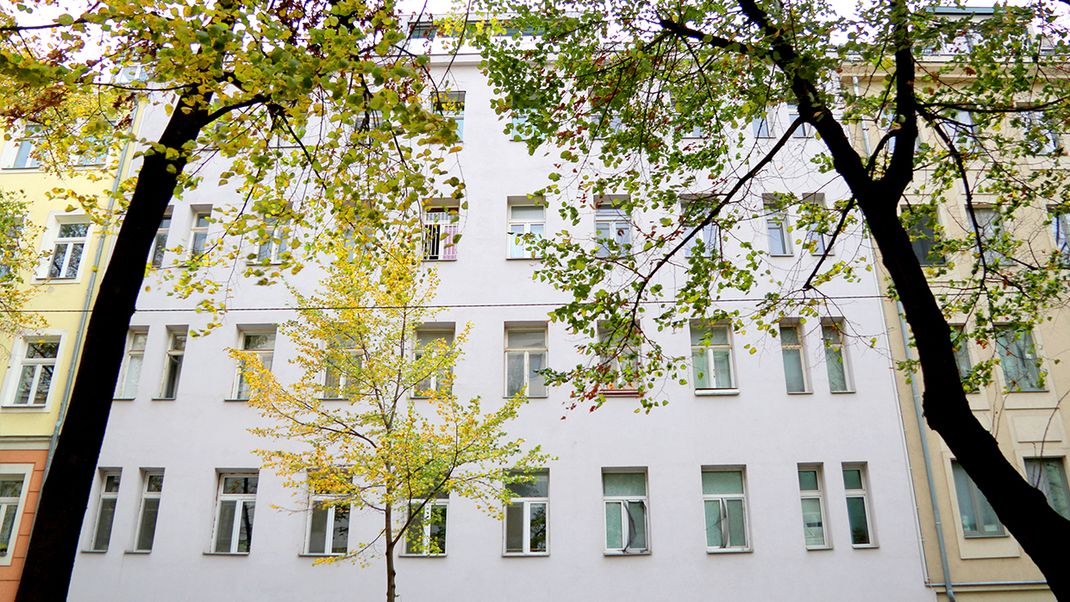
The key task for the coming years is to find solutions for existing buildings and convert existing heating systems to a renewable energy supply. The enormous number of fossil-fuelled heating systems, in combination with a historic built fabric in which the outer shell of buildings and their technical installations are frequently of substandard quality, not to mention the architectural limitations, present a huge cluster of challenges when it comes to phasing out fossil fuels and achieving the climate targets.
This project tackles all the above issues.
This early-20th-century residential building on Ybbsstraße in Vienna's 2nd district is to become a showcase for innovative energy solutions in older buildings.
Built in 1908, the building comprises flats on five storeys and has a typical heating system of individual gas boilers.
Wherever appropriate insulation makes it technically feasible to do so, the existing gas heating boilers are to be successively replaced with a groundwater heat pump system.
Takeaways & challenges
- Analysis has shown that a heat pump solution without accompanying thermal insulation results in a largely electricity-based heating system, which does not fulfil the criteria for a renewables-based system. Furthermore, the electrical capacities required would entail substantial modification of the electrical wiring system. For this reason, an economically and technically practical renewables-based heating and cooling system is only feasible if the heat energy requirement is reduced from 66 to around 30–40 kWh/m²a by the planned thermal insulation. Going forward, the new OIB Guideline introduced in 2025 will allow more reliable evaluations of suitability for low-temperature systems.
- Decision-making processes in commonhold associations usually require a great deal of time and consultation due to the clash of different interests and varying levels of information and awareness. The number of commonhold associations who decide to go ahead with retrofitting concepts is significantly lower than the figure for sole owners.
- Complex modernisation or energy retrofitting projects involving commonhold associations require continuous, neutral moderation or mediation, ideally in parallel with the project phases. Property management companies and engineering firms do not usually have the necessary moderation or conflict resolution expertise to successfully facilitate and manage this process.
- Investment decisions are often a source of anxiety and uncertainty. Clear, transparent communication is required to set out exactly what is being decided, what consequences result from that, and what the financial implications are.
- To ensure planning certainty, funding schemes should not end abruptly but be gradually adjusted over time. The possibility to combine regional government and neighbourhood-level subsidies could create additional incentives and facilitate project delivery.
The subsidy schemes for retrofitting projects provide valuable support and create a solid basis for decision-making. The ideal scenario would be a combination of federal and regional government funding, which together would allow a total funding rate of 100% for retrofitting projects.
WieNeu+ was crucially important to this project: without WieNeu+ it would never have got off the ground. The additional "Grätzlförderung" funding, in particular, was a decisive factor at the start.
This project was supported with funding from the "Grätzlförderung" scheme.
Project partners
- Hausverwaltung Obermeier GmbH (property management company)
- Schöberl & Pöll GmbH (structural engineers)