5.5 Alternative energy feasibility study: Castellezgasse 35-37, 1020 Vienna (commonhold association)

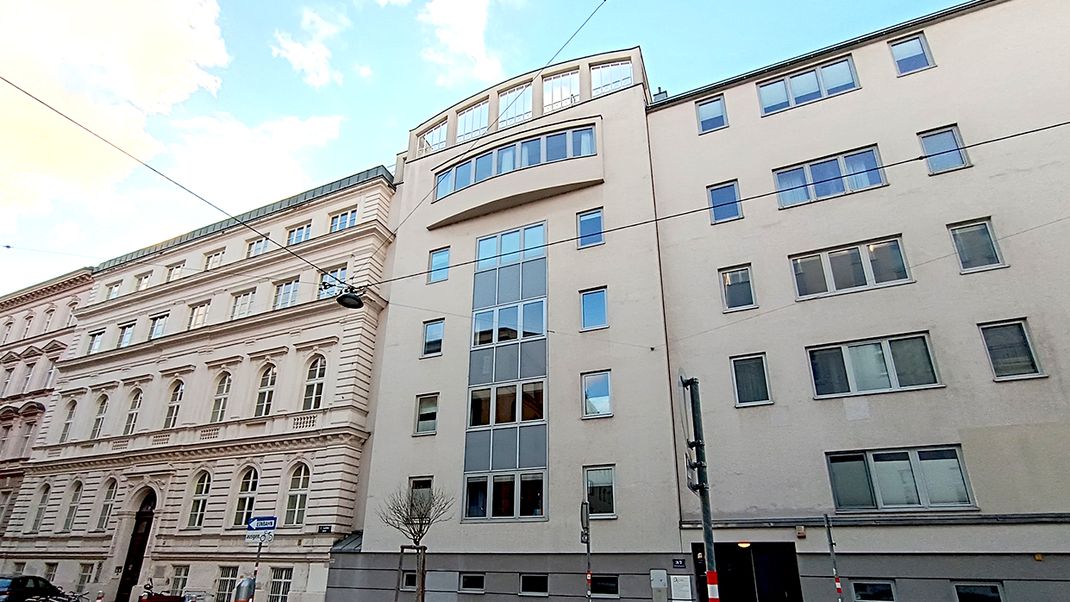
The commonhold association of the residential buildings at Castellezgasse 35 and 37 (2nd district) commissioned Schöberl & Pöll GmbH to perform a feasibility study on converting the current gas-powered heating and hot water supply to a sustainable energy solution. The study analysed the use of a water/water heat pump based on thermal energy from groundwater.
The two buildings differ in terms of their age and structural details: Castellezgasse 35 (built 1884, thermal insulation retrofit 2010) and Castellezgasse 37 (newly built 2010) have a combined gross floor area of over 4,300 m². At present they have a decentralised heating and hot water supply via gas boilers in the individual flats.
The feasibility study shows that centralisation of the thermal distribution system is absolutely necessary. In future, thermal energy is to be generated and distributed from a new plant room in the basement. The funding eligibility criteria specify a maximum flow temperature of 40°C, so a hot water supply via additional booster heat pumps is envisaged. At the same time, the installation of rooftop photovoltaic panels is being considered to supply some of the electricity required by the heat pump and enhance the buildings' energy self-sufficiency.
Takeaways & challenges
- The heat supply in the existing buildings can be decarbonised, but requires centralisation of the thermal distribution system.
- Use of thermal energy from groundwater is technically feasible, but requires a detailed assessment of the geological situation and water legislation.
- The funding criteria (flow temperature max. 40°C) necessitate an adapted system concept incorporating booster heat pumps. (Note: The funding criterion was amended as of 01/2024. The maximum flow temperature has now been increased to 55°C.)
- The use of rooftop solar potential can significantly reduce operating costs and CO₂ emissions.
- The ownership structure (commonhold association) is a challenge: decisions require majority approval, but this makes implementation far more complicated.
- The question of funding: investment costs and subsidy options are crucially important for project implementation.
To date, solar panels have been installed on the flat roof. Further measures are currently being evaluated.
This project was supported with funding from the "Grätzlförderung" scheme.
Project partners
- Castelletzgasse 35 and 37 commonhold association
- Schöberl & Pöll GmbH (structural engineers)