7.4 Stadtkern_PLUS spatial project
The Stadtkern_PLUS project established spatial commons in existing city neighbourhoods with a view to producing a positive social, inclusive and sustainable impact. Within the context of the project, spatial commons were understood to mean spatial resources that are shared and collectively managed for the benefit of the community.
Project activities
- Information-gathering, assessment of local needs and establishment of a stakeholder network
- Neighbourhood morphology and socio-spatial analysis
- Analysis of the legal framework
- Survey on space requirements in Vienna
- Knowledge- and capacity-building for the set-up of spatial commons
- Use of various formats to build networks of local stakeholders on the demand side
- Building of capacities for local spatial commons networks
- Development of a range of models for spatial commons
- Organisation and set-up of initial pilot projects
- Grätzlzentrum+: The Grätzlzentrum+ community space is located in a former kindergarten in the Johann-Kaps-Hof municipal housing complex. Since early 2025 the premises have been under the management of the charity organisation Volkshilfe Wien, which makes them available free of charge as a low-threshold, flexible-use space for local people and initiatives.
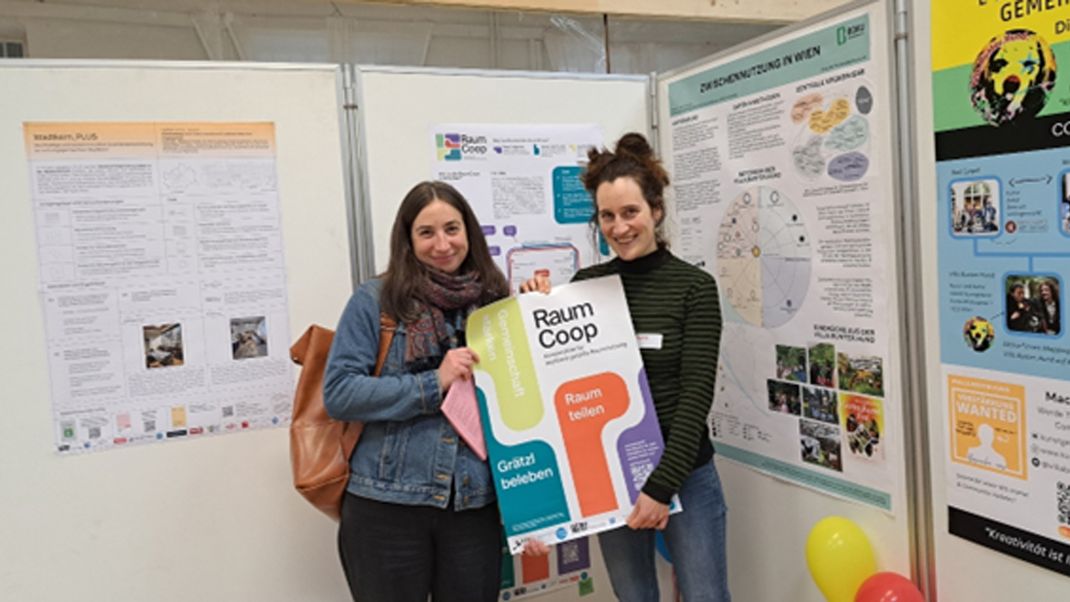
- RaumCoop pilot: The non-profit association RaumCoop organises shared-space projects, activates underused premises in the ground-floor zone for non-residential use and makes these available for temporary use at affordable rates. RaumCoop road-tested the concept in a pilot phase from autumn 2024 to spring 2025. However, the RaumCoop project could not be continued after the pilot phase for lack of a financial backer.
- RaumBooster by imGrätzl.at: Using a combination of crowdfunding and funding from other sources, Raumbooster helps local stakeholders to activate (vacant) premises or keep spaces already in use.
Takeaways & challenges
- Community-based sharing of spatial resources (spatial commons) is a beacon of hope for sustainable development of existing urban areas. Multiple-use cooperatives in underused spaces not only make environmental sense, but are also desirable from the social perspective. Urban renewal programmes thus have great potential for making affordable space available to local grassroots activists – aside from classical projects to activate vacant properties for interim use.
- The implementation of the three initial pilot projects confirmed that spatial commons embedded in the local neighbourhood generate socially robust, continuously renewed practical expertise and build supportive networks.
- Sharing of spaces requires extensive knowledge in many different fields (regarding legal, structural, financial and organisational aspects, etc.) and substantial investments of time and resources by the involved stakeholders. To this end, the City of Vienna can create and/or develop support structures to relieve the burden on those sharing the space.
The project received funding from the Austrian Climate and Energy Fund and was implemented as part of the programme "Beacon Projects for Resilient Cities 2040 – 2021 call for proposals". The project ran for 38 months in total (03/2022 – 04/2025).
The publication "Sharing: Possible! – Praktiken des Teilens in der städtischen Erdgeschoßzone" (Mara Haas/Christian Peer/Dominik Wagner/Paul Hahnenkamp) ("Sharing: Possible! – Sharing Practices in Urban Ground-Floor Zones"), produced as part of the Stadtkern_PLUS project, is free to download.
Link
Project partners
- future.lab Research Center, TU Wien (project lead)
- Law Research Unit, TU Wien
- morgenjungs GmbH (digital platforms consultancy)
- Volkshilfe Wien (charity organisation)
- City of Vienna – Municipal Department for Technical Urban Renewal (MA 25)
- RaumCoop e.V (non-profit association)
- City of Vienna – Wiener Wohnen (municipal housing agency)