7.2 Volkert macht Blau – pilot project for climate adaptation measures

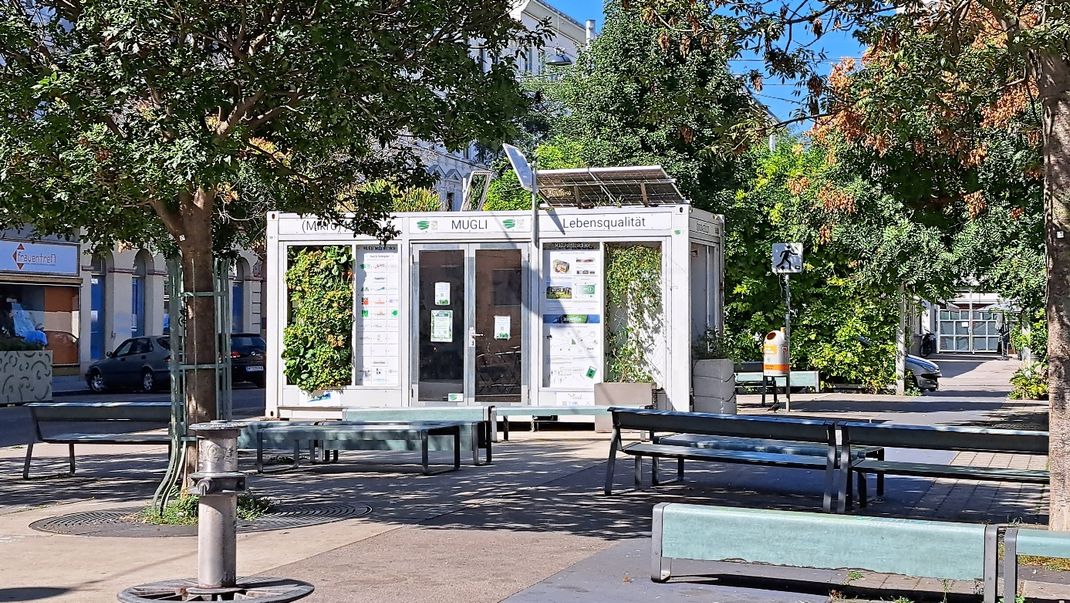
"Volkert macht blau" was an interdisciplinary research project in the public space that was carried out on Volkertplatz in the Grätzl 20+2 programme area as part of WieNeu+.
The objective was to find a solution for an integrated water management system, consider climate change adaptation and climate protection options, and develop various co-creation formats in a real-life setting.
A key focus of the project was to develop a concept for installation of a so-called BARTLETT ("blue-green photovoltaic shading module"). The BARTLETT was designed to incorporate a shading element, photovoltaic panels and a "sponge city" water management system in a single unit. It highlights the technical challenges associated with urban heat islands and proposes concrete solutions.
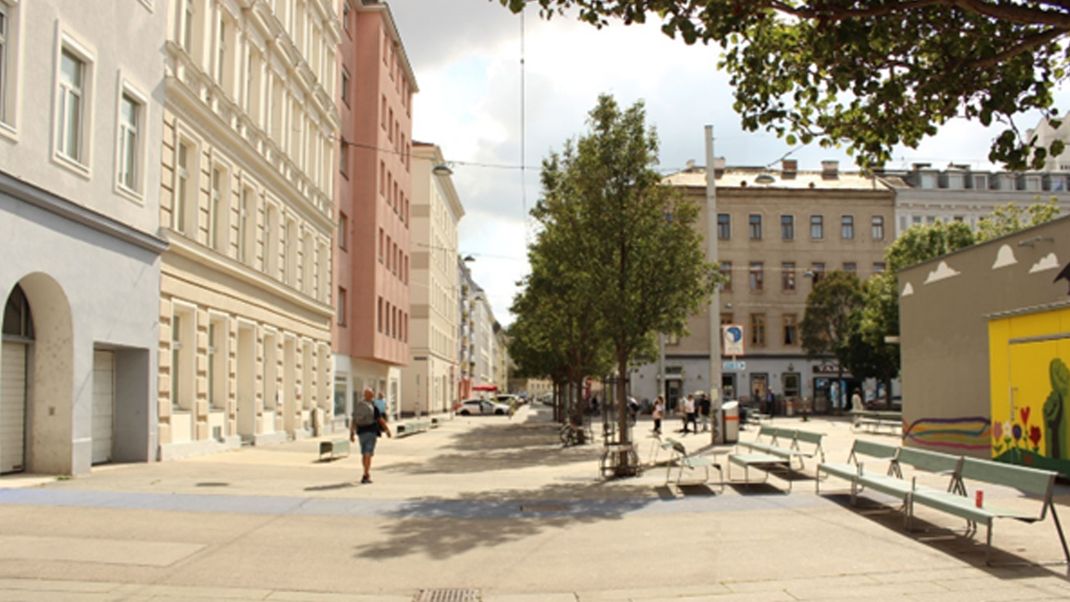
Takeaways & challenges
- WieNeu+ proved its worth as a platform for applied research projects.
- WieNeu+ provided the framework for development of the BARTLETT concept, which is now being adapted for further use by GrünStattGrau and the architectural practice Tillner & Willinger.
- Precipitation falling on the photovoltaic roof structure can be channelled uncontaminated into an absorbent "sponge" element for storage and then used to irrigate nearby trees and plants.
- The module cannot be installed in all locations for technical and/or economic reasons.
- The municipal district, as the body funding construction of such a module for public spaces, cannot use solar power directly.
Find out more here: https://www.tw-arch.at/index.php?inc=projectSelection&id=166:3636&lang_id=en (German)
Project partners
- Austrian Institute of Technology (AIT)
- Grimm landscape architects
- GrünStattGrau (research and innovation lab)
- Tillner & Willinger architects
- Local Urban Renewal Office (GB*), Neighbourhood Management team for the Nordbahnhof and Nordwestbahnhof development zones