5.3 Requirements and objectives for Vienna’s construction sector
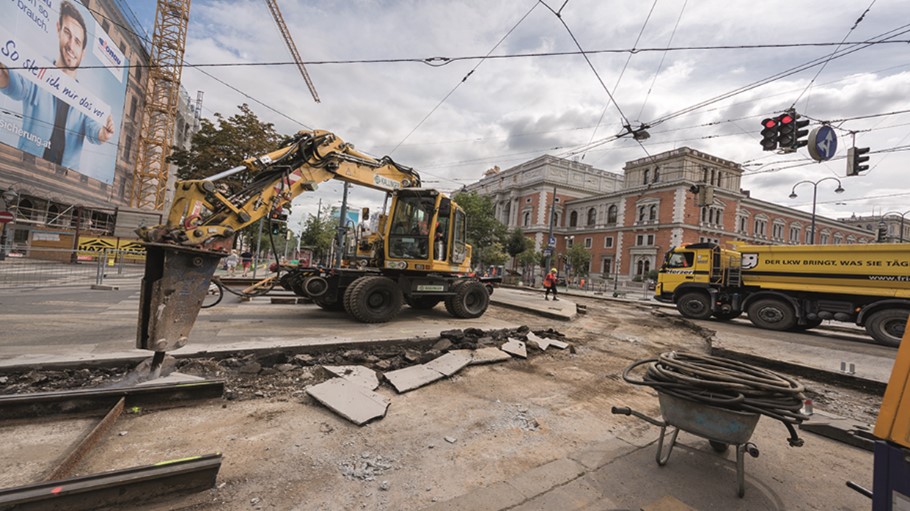
The implementation of the circular economy in the construction sector is guided by the following parameters.
Framework conditions at EU and federal level (see also Chapter 2)
- EU Energy Performance of Buildings Directive (EPBD) (Directive (EU) 2024/1275): As part of the Renovation Wave for Europe strategy, the Energy Performance of Buildings Directive (EPBD) is particularly relevant for advancing circular construction, as it calls for an integrated approach combining decarbonisation with circular refurbishment measures. In Austria, the EPBD is transposed into regional building regulations via directives issued by the Austrian Institute of Construction Engineering (Österreichisches Institut für Bautechnik, OIB).
- EU Construction Products Regulation (Regulation (EU) 2024/3110): This regulation introduces a combined declaration of performance and conformity in connection with CE marking. It establishes requirements for demonstrating the environmental sustainability of construction products and introduces a digital product passport system for construction products.
- Landfill Ordinance: The amendment to the Landfill Ordinance 2008 (Deponieverordnung 2008, DVO 2008, Federal Law Gazette II No. 291/2016) regulates, in addition to requirements for landfill sites, aspects such as construction, operation, closure and aftercare of landfills. Promoting the circular economy in line with the waste hierarchy is anchored as a clear objective of the ordinance (for example, the landfill ban on gypsum plasterboards from 2026 onwards).
- Recycling Construction Materials Ordinance: This ordinance (Recycling-Baustoffverordnung, Federal Law Gazette II No. 243/2024) defines the national framework for recycling-oriented deconstruction. It is of particular importance for the construction sector, as it – together with the associated standard ÖN B 3151 – establishes recycling-oriented deconstruction as the mandatory standard demolition method in Austria.
- Reduction of land take: As early as 2002, the Austrian Strategy for Sustainable Development defined a general objective to reduce daily land take across Austria to 2.5 hectares per day. This objective has since been taken up in substantive terms by the current federal government, with the aim of developing a strategy to achieve this target jointly with the federal provinces by 2026. Vienna supports this objective and already makes a comparatively small contribution to land take compared with all other federal provinces.
Key objectives for a resource-saving built environment in Vienna
The objectives for implementing the circular economy in the construction sector are already embedded in the City’s overarching strategies and sectoral strategies. Particularly significant in this regard are the Smart Climate City Strategy Vienna, the Vienna Climate Roadmap, the Vienna Business Strategy 2030 (including the Digitalisation Agenda), the Vienna Waste Management Plan and the Waste Prevention Programme 2025–2030, the Vienna Heat and Cooling Concept 2040, and the Vienna Plan – Urban Development Plan 2035.
- Circular construction as the standard in the building sector from 2030: Circular, resource-saving planning and construction aimed at maximising resource saving will become the standard for new builds and refurbishments from 2030. (Smart Climate City Strategy Vienna)
- 70 per cent reusability by 2040: By 2030, reusability in new construction will become the new planning standard. From 2040 onwards, reuse-oriented deconstruction will become standard practice, ensuring the reusability of at least 70 per cent of building elements, products and materials. (Smart Climate City Strategy Vienna)
- Low land take and high-quality open spaces: Vienna’s green-space share of more than 50 per cent will be safeguarded over the long term, and natural soil functions will be protected through the preservation and creation of unsealed surfaces. (Smart Climate City Strategy Vienna; Agricultural Structural Development Plan – AgSTEP; Vienna Plan – Urban Development Plan 2035)
- Preservation and adaptation or further development of the existing building stock: The continued use of buildings takes precedence over demolition wherever possible. The existing building stock is to be used for as long as possible and adapted where necessary. Durable buildings that allow for flexible use are promoted both in the development of existing stock and in cases where new construction is required. (Vienna Plan – Urban Development Plan 2035)
- Space and infrastructure for the circular economy: Vienna safeguards sufficient and appropriate space. Premises and infrastructure for the circular economy - from the Grätzl to the city-regional level - are taken into account in planning. (Vienna Plan – Urban Development Plan 2035)
- Compact and urban districts: Settlement structures are planned in a land- and space-efficient manner, in line with the principle of the city of short distances. (Vienna Plan – Urban Development Plan 2035)