5.2 Investing in the future
Circularity pays off and ensures long-term affordability
Efficient use of materials, along with durable construction methods and maintenance concepts that enable repairs and the targeted replacement of individual components, increases economic viability over the entire life cycle. Separable building components facilitate reuse, while repairability reduces the need for new materials and promotes sustainable construction methods. Easily adaptable building structures allow for flexible adjustment to changing uses. A high degree of prefabrication accelerates construction processes and minimises construction waste.
Vienna has been a pioneer of social and affordable housing for over 100 years. Around 25 per cent of all primary residences are directly owned by the City or by comparable public bodies, with a further 19 per cent managed by non-profit housing associations. Social housing, which continues to be expanded through high-quality new construction, therefore plays a central role. The refurbishment and further development of the existing building stock also follow the principles of the circular economy, value retention and cost-efficiency. This makes a significant contribution to the social orientation of Vienna’s housing policy and to the provision of affordable housing in Vienna.
Recognising and using the city as a material stock
Vienna’s built environment is to be used as a “material stock of the future” by preserving existing structures as effectively as possible and closing the loop between deconstruction and new construction. The extraction and processing of primary resources and raw materials account for a large share of the transgression of planetary boundaries (see also Chapter 1). At the same time, the availability of certain raw materials from natural deposits is increasingly declining. Circular construction uses the city itself as a material stock, reducing the extraction and use of primary resources through the use of secondary materials and reusable building components. Resources already embedded in buildings are recovered at the end of their service life, reused at a high quality and thus kept in circulation as secondary resources.
Efficiency as a guiding principle for Vienna’s adaptation and further development
This principle entails the continued economical use of land, as well as the highest possible level of compactness and use density in new construction. It includes the high-quality further development of existing neighbourhoods and buildings, the reduction of vacancy and densification within the existing urban fabric. As the population grows, efficiency ensures the greatest possible saving of resources in the adaptation and further development of the city. In circular construction, efficiency also stands for “slimness”: material-optimised components and structures in both building and civil engineering, in every respect, while at the same time taking account of adaptability and durability. The aim is to build “more with less” – in terms of optimised construction processes, reducing material losses in production, and using and combining materials that are circular-compatible together.
Thinking from beginning to end: considering the life cycle of a building
Longevity, ease of repair, adaptability to new uses and deconstructability are essential components of circular construction. These qualities must be ensured from the outset. For this reason, the entire life cycle of a building – including the materials it contains and its technical infrastructure – is taken into account from the earliest stages of planning and decision-making.
Environmental protection and cost efficiency go hand in hand and are key criteria in procurement. Achieving this requires effective tools for planning and construction practice, with digitalisation playing a decisive role. Building Information Modelling (BIM) and digital twins create the conditions for a high degree of circularity across all phases of a building’s life cycle: from planning and implementation, through operation, maintenance and further development, to reuse-oriented deconstruction. In this way, material cycles are closed and resources are used optimally.
Consume LESS, use LONGER, reuse AGAIN – the strategies of circular construction
Consume LESS: Careful use of land as a resource; minimising the consumption of energy-intensive (primary) raw materials through sufficiency and efficiency strategies in planning; the use of renewable, reused and recycled materials and components; and the use of ecologically high-quality materials with the lowest possible environmental impact – in particular with regard to greenhouse gas potential over the entire life cycle.
Use LONGER: Extending service life through modularity and adaptability; construction solutions designed for durability; avoidance of construction defects through quality-compliant and contract-compliant building practices; and ease of maintenance and repair.
Reuse AGAIN: Closing material cycles through the use of building materials and construction methods that are easily reusable and that support value-preserving deconstruction, forming the basis for the high-quality reuse of materials.
In practice, this means prioritising prefabricated, modular and easily deconstructable building components; allowing ageing processes to remain visible; designing components to be demountable; and installing cables and services so that they are easily accessible. To ensure that repairs can be carried out easily, the construction follows a hierarchy of components based on service life and allows for the targeted replacement of individual elements. The aim is to ensure that, at the end of a building’s life cycle, as little waste as possible is generated and that a material cycle is created instead.
Different measures contribute to saving resources and to circular construction in different ways – there is no single, universally applicable solution. Rather, each construction task requires a holistic assessment that takes location, function, material choice and context of use into account. Potential goal conflicts or contradictions are not obstacles, but integral components of a reflective and solution-oriented planning process.
Cooperation and innovation for the transformation in planning and construction
The transition to a circular construction sector requires a comprehensive systemic change and cooperation along the entire value chain. At present, the use of new materials is often less expensive, while a functioning market for secondary construction materials is lacking. Uncertainties relating to liability law make the reuse of building components more difficult. The polluter-pays principle and extended producer responsibility are not yet established as legal standards. In the demolition of older buildings not designed in line with circular principles, the use of poorly separable composite materials prevents reuse. Downcycling continues to dominate recovery strategies. There is also a lack of data, product information and consistent assessment methods across the entire life cycle.
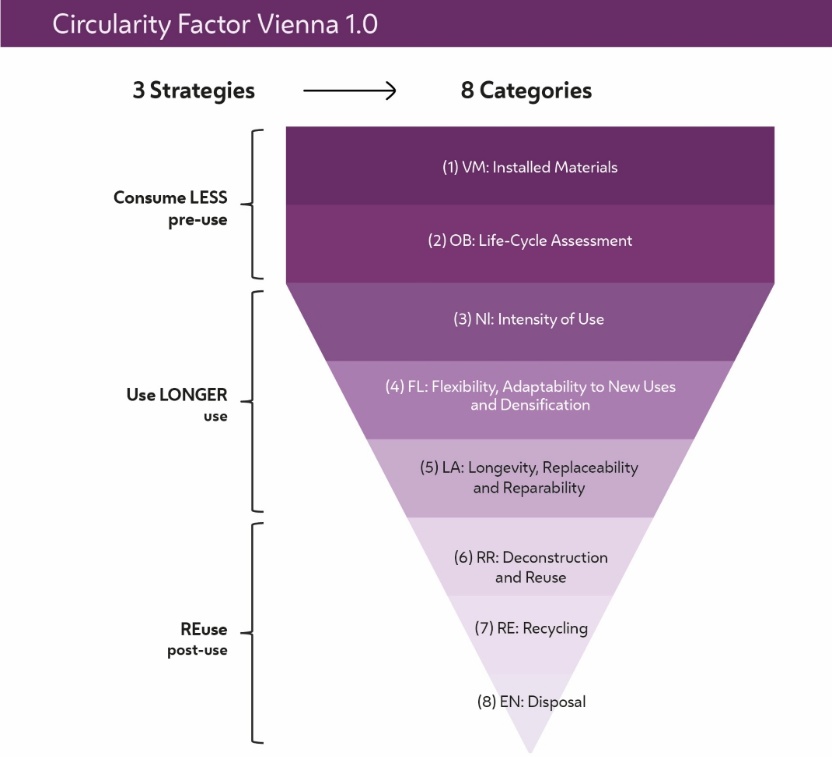
To make circular planning and construction the standard, clear criteria are needed to define what this entails. The Circularity Factor (ZiFa) supports this process as a central tool for transformation. Developed as a scientifically sound assessment system within the DoTank Circular City Wien 2020–2030 programme, it has been tested and further developed in real construction projects. The focus is not solely on the final assessment method, but above all on the path towards it – with the aim of making effective measures visible and rendering circular construction tangible and practical to implement.