4.1 Durable products and new services

Our handling of electrical appliances, textiles and food has a major impact on the climate and the environment
To translate the 10-R principles of the circular economy (see Chapter 3) into reality, society needs a new awareness, as well as companies that offer expert repair services and manufacture durable products. It must also be easy for people in Vienna to repair goods themselves, to establish second-hand as part of everyday consumption, and to sort waste. To achieve this, they need the appropriate structures in their living and working environments.
Since the 2020s, there has been a growing trend towards civil-society initiatives related to waste prevention. Do-it-yourself repair initiatives such as repair cafés, repair workshops and open repair studios contribute to preventing waste and raise awareness of resource-saving consumption. Initiatives for the shared use of resources (sharing economy), such as exchange initiatives, borrowing shops or Grätzlteiler (neighbourhood-sharing points), reduce the need for products and the resulting waste. Further examples include food co-ops and urban-gardening initiatives (for example community gardens), which support more mindful handling of food and can help prevent food waste and food-packaging waste.
These initiatives are often driven by the strong commitment of volunteers and generate ecological and social benefits for society. The City of Vienna can support this civil-society engagement by creating favourable framework conditions and appropriate infrastructure.
Societal acceleration as a driver of resource consumption
The globalisation of the economy, unrestricted access to information and digitalisation are accelerating societal trends - factors that contribute directly to rising resource consumption. In addition to negative impacts on health, quality of life and social cohesion, this acceleration has devastating consequences for the environment and the climate. The circular economy has the potential to counter this trend. Efficiency improvements, sufficiency measures and circular concepts are key pillars in this regard.
Given their significance in everyday consumption, the following products and services are central priorities of Austria’s circular-economy strategy and the EU Circular Economy Action Plan (see Chapter 2).
Textiles as essential consumer goods in everyday life
The textile industry is, after the food industry, the second largest consumer-goods sector worldwide. Globally, textile production now exceeds 120 million tonnes per year, with forecasts predicting an increase to around 140 million tonnes by 2030. On average, people in Europe buy around 26 kilograms of new textiles each year. The entire textile sector has negative effects on the climate, water consumption and the environment - from the use of harmful chemicals in production, through CO₂ emissions associated with long transport routes, to environmental impacts from washing, cleaning and disposal.
In 2022, almost 228,000 tonnes of textile waste were generated in Austria (including wearable and damaged used textiles, household textiles and production waste), with a further 47,000 tonnes imported. Only around 54,000 tonnes were collected separately as used textiles; 87 per cent of this amount is exported, often to third countries. The majority of all textile waste (approximately 80 per cent of the total 275,000 tonnes) is still incinerated as mixed municipal waste (for example residual waste, bulky waste and commercial waste). Only 13 per cent is currently used to meet second-hand demand, 5 per cent is recycled and a further 2 per cent is disposed of through technical treatment.
In Vienna, the volume of used textiles is expected to reach 6,000 tonnes in 2024, with an increase to 9,000 tonnes forecast by 2030. Closing the material cycles of the textile sector (for example through reuse or fibre recycling) therefore represents an important contribution to saving resources.
Electrical and electronic equipment in digital and analogue contexts
The consumption of electrical and electronic equipment has risen rapidly in recent decades. The trend continues to move towards short-lived products with increasingly short service lives.
This results in increasing resource and energy consumption, with far-reaching environmental impacts. In Vienna, more than 8,000 tonnes of waste electrical and electronic equipment are collected and processed each year at the municipal waste collection centres of MA 48 – Waste Management, Street Cleaning and Vehicle Fleet. This includes around 3,100 tonnes of iron, 200 tonnes of aluminium and around 300 tonnes of copper - all of which are valuable raw materials for the manufacture of new products. The circular economy supports a sustainable and socially equitable electrical and electronic industry by reducing the consumption of primary resources in both production and consumption.
Ever-increasing packaging waste
Despite efforts to reduce packaging waste, it continues to rise across EU Member States. In 2021, packaging waste amounted to 84 million tonnes - a 25 per cent increase over the past 10 years. Without countermeasures, packaging waste could rise by a further 19 per cent by 2030. The main drivers are packaging-intensive online shopping and the consumption of takeaway food. The simultaneous increase in recycling rates has not yet been able to counter these trends. This shows that efforts focused solely on waste separation and packaging recycling are not sufficient; a societal transformation towards avoiding, reusing and sharing is needed to reduce packaging waste effectively (see also Chapter 3).

Nutrition and food as major levers
The food sector is one of the largest contributors to greenhouse gas emissions, biodiversity loss, water consumption, disruption of nitrogen and phosphorus cycles, chemical pollution, land-use change and the overfishing of the oceans. Around half of the habitable land surface of the Earth is used for agriculture. Worldwide, more than half of climate-relevant emissions in the food sector originate from livestock farming. Animal-based products supply only 18 per cent of human calorie intake and 37 per cent of protein intake.
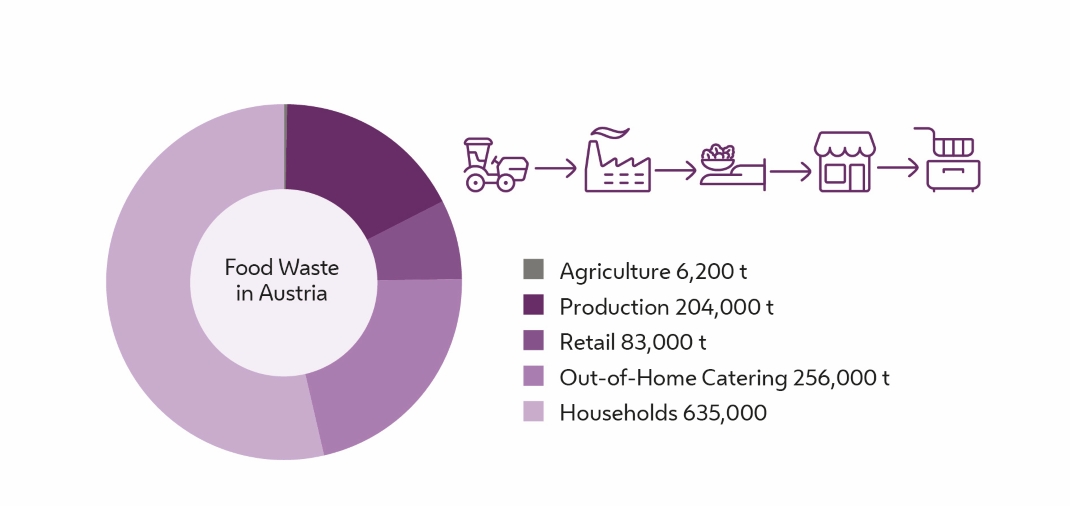
Almost 1.2 million tonnes of avoidable food waste are disposed of across Austria each year. Private households account for around 54 per cent of this total (see Figure 10). The remaining half-million tonnes are attributable to the upstream stages of the value chain - retail, gastronomy and agriculture. Along the entire value chain, this corresponds to around 130 kilograms per person per year. The largest shares are bread, sweet and baked goods (28 per cent), followed by fruit and vegetables (27 per cent).
In addition to reducing food waste, closing local and regional cycles is important for a resource-saving food supply. Thanks to its vegetable and arable farming businesses, plant nurseries and vineyards, Vienna has a well-functioning system of city-based agriculture. Around 200 vegetable-growing businesses ensure the supply of regionally and seasonally produced vegetables in Vienna. Around 15 per cent of Vienna’s land area is used for agriculture, one third of which is organic farming. The long-term safeguarding of agricultural land in Vienna and its surrounding region is essential for supply security and crisis preparedness for all people in Vienna.
The Vienna food sector - comprising agricultural production, food processing, retail and gastronomy - contributes a notable 7 per cent to regional value creation, with a particular focus on the downstream stages of the value chain such as retail, transport and gastronomy. The lever for reducing environmental impacts in the food sector is also substantial in Vienna: up to 80 per cent of the greenhouse gas emissions of the food sector could be avoided through a substantial reduction in the consumption of animal-based foods. A further 10 per cent of greenhouse gases could be saved in food production, and 5 per cent through a reduction in food waste.
Under the umbrella term Stadternte Wien (Vienna’s city-based agriculture brand), the focus is on the regional production of food and on direct sales “from the farm” and through markets. This makes ecological sense: short transport routes, local value creation and higher quality.
The health, care and social sector is part of everyday life for many and requires resources
Health, care and social services are part of everyday life and, for many people in Vienna, form part of their everyday working reality. The Vienna health sector comprises numerous facilities for medical care, nursing care and health promotion for the population. Clinics, outpatient centres, emergency and rescue services, nursing and care facilities, pharmacies, research institutions and many others contribute to the health of people in Vienna. This generates a high demand for energy, food, consumer goods and medical products, and leads to substantial greenhouse gas emissions and large volumes of waste.
The Vienna Healthcare Group (WiGeV) is one of the largest healthcare institutions in Europe, with 7 clinics, 9 care homes, 1 therapy centre and 5 training locations. It employs around 30,000 staff. In 2022, it provided inpatient care for around 229,000 people with a total of around 10,000 beds, and around 2,400 people in care homes. Meals are provided daily for thousands of people.
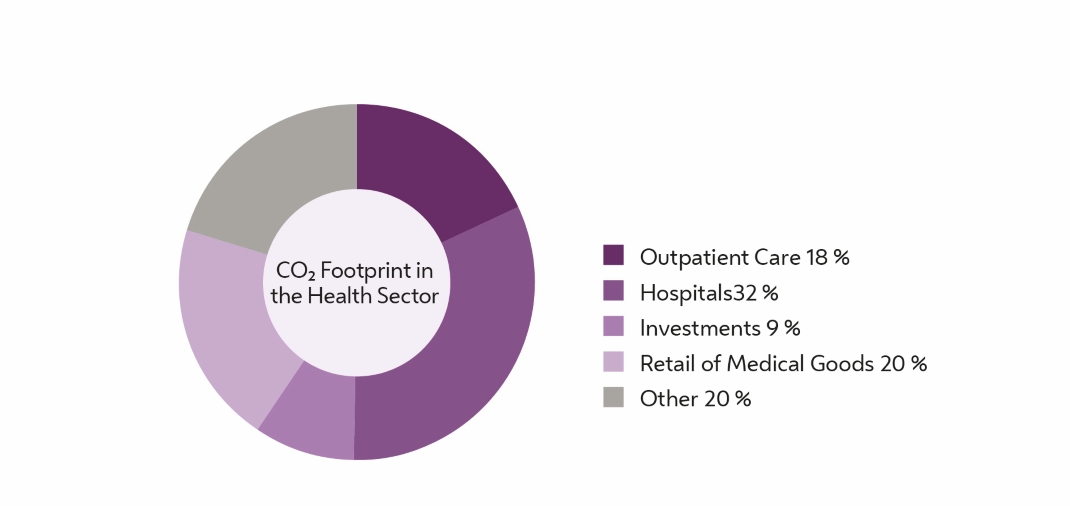
The health sector is responsible for around 7 per cent of Austria’s consumption-based CO₂ footprint. Around one third of emissions are caused by Austrian hospitals. A further 20 per cent are generated by the retail trade in medical goods, including pharmaceuticals and medical products. Another 20 per cent result from areas such as long-term care or support services. Eighteen per cent of emissions arise from outpatient hospital care and community-based medical services. The remaining emissions are generated by investments in the health sector (see Figure 11).
“Fighting unnecessary resource consumption is also a profoundly social task. It begins with food waste, extends to everyday consumption and reaches all the way to the most environmentally compatible social and leisure infrastructure possible. This is not about going without as a matter of principle, but about the intelligent planning and provision of all the things that make life in Vienna affordable and liveable at a high standard.”