
1.1 Mobility
In the Austrian capital, public transport, walking, cycling and car sharing services provide valid alternatives: At the moment, Vienna is extending the U2 Underground line, constructing the new U5 Underground line as well as modernising and enlarging its network of tram lines. The twin objectives of providing particularly frequent services as well as modern, attractive and barrier-free public transport stations for Vienna are further pursued by upgrading the rail link from Vienna-Hütteldorf to Vienna-Meidling, four-tracking the southern railway line between Meidling and Mödling in Lower Austria and modernising the main S-Bahn commuter line between Meidling and Floridsdorf.
240 WienMobil hubs, which offer WienMobil bike sharing at all locations as well as electric car sharing at 100 hubs, provide solutions for different mobility needs in one single package. The City of Vienna’s Co-ordination Unit for Service Sharing (KOSMO) organises all other mobility sharing options together with Wiener Linien, Vienna’s public transport provider. The “WienMobil Hüpfer” – an electric minibus – is testing on-demand transport in peripheral areas. Vienna is also implementing the biggest-ever cycleway construction project by building about 20 kilometres of new cycleways per year and investing over € 100 million during the legislative period from 2021 to 2025.
Sidewalks are optimised to ensure barrier-free design and sufficient width. The strategic basis for this measure is provided by the Master Plans for Walking at district level.
Mixed-use neighbourhoods, areas with traffic calming, improved sidewalks, upgraded cycleways and the planning of new pedestrian and bicycle bridges support Vienna’s planning approach to create a city of short distances. Pilot projects like “Supergrätzl Favoriten” in the 10th municipal district decelerate traffic flows and enhance atmospheric quality and climate comfort.
The introduction of 30 km/h speed limit zones supports attainment of the Vision Zero objective of preventing traffic fatalities. Since 2022, all of Vienna has been subject to a short-term parking system. A zone model regulates the legal requirement to provide a certain mandatory number of parking slots for new construction projects as well as for structural modifications and additions in conjunction with their accessibility by public transport. More than 400 locations of the WienBox freight logistics platform situated in publicly accessible spots reduce local parcel delivery traffic. Vienna promotes corporate mobility management and sets a good example: The employees of the City of Vienna and the Vienna Public Utilities are issued free-of-charge job tickets, and Wiener Linien advises Vienna’s enterprises on staff mobility issues.
Electric mobility is promoted by more than 3,100 charging outlets so far. These were set up at publicly accessible charging stations for electric vehicles (of these, 2,750 are standard charging outlets and 350 are fast charging outlets); moreover, WiPARK parking garages have upgraded their charging infrastructure. In the first six months of 2025, the Implementation Programme for Electric Mobility will serve to define a strategic course for action regarding electric mobility. Decarbonisation plans for the municipal vehicle fleets are underway.
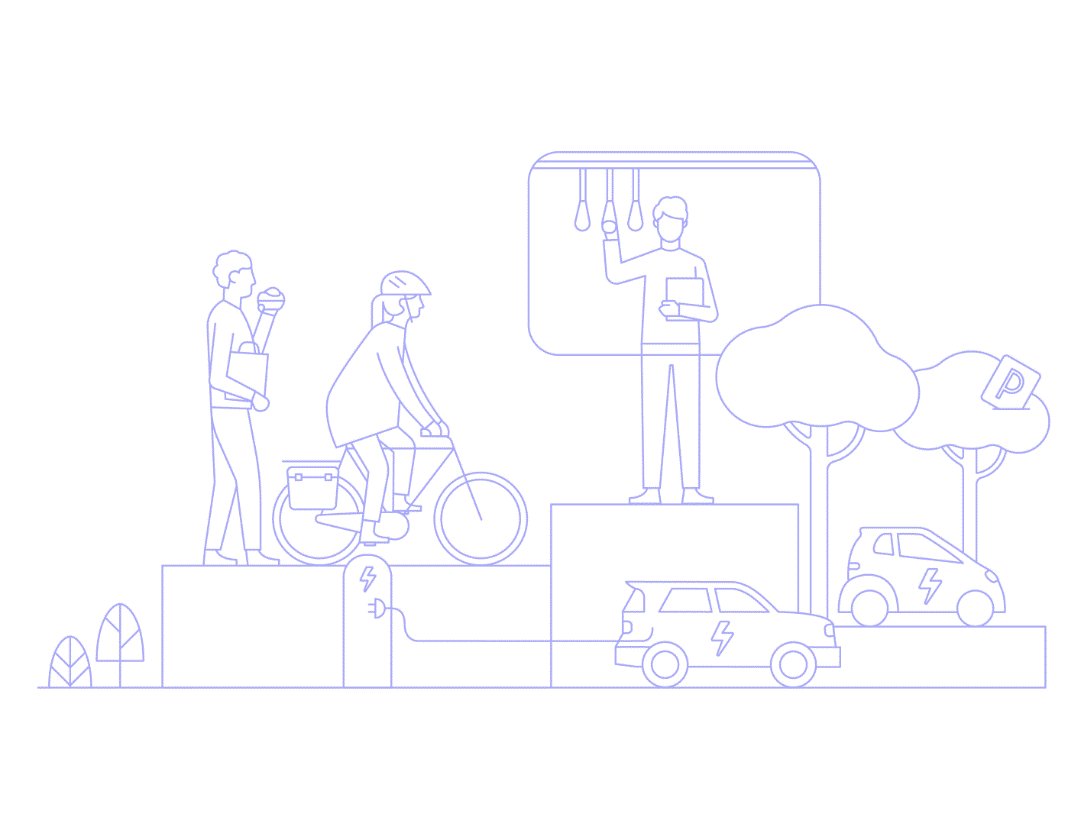
Highlights:
-
Extension of U2 line, construction of U5 line, upgrading of tram lines 12, 18 and 27
-
Upgrading and modernisation of railway infrastructure
-
240 WienMobil bike hubs and 100 WienMobil electric car sharing points
-
Investment volume of € 100 million in cycling mobility (2021-2025)
-
Safe pedestrian and cycling mobility due to traffic calming and speed limits (30 km/h zones)
-
The entire municipal area of Vienna is one single short-term parking zone
-
A zone model curtails the legal requirement to provide mandatory parking slots for new construction projects, structural modifications and additions in conjunction with accessibility by public transport
-
Over 400 WienBox locations
-
Free-of-charge job tickets for municipal employees
-
Roughly 3,100 charging outlets at publicly accessible charging stations
-
60 new electric buses and 10 hydrogen-powered buses
-
Framework agreement between Vienna Public Utilities and Municipal Department 48 – Waste Management, Street Cleaning and Vehicle Fleet: 1,245 climate-neutral utility vehicles by 2032