4.3 Focal points for saving resources in everyday life in Vienna

The following focus areas and levers show how the transformation can succeed in relation to food and products of all kinds.
- Resource-saving consumption
- Resource-saving food production, catering and nutrition
- Saving resources in Vienna’s health, care and social sectors
Resource-saving consumption
Resource-saving and circular consumption in everyday life in Vienna requires framework conditions and structures that make purchasing, repair, return, collection and disposal straightforward within people’s immediate living and working environments. For this, offers, infrastructure, spaces, premises, communication and awareness are necessary prerequisites.
A strong, local, diverse repair and second-hand economy - one that appeals to target groups with different needs and levels of purchasing power - is a fundamental requirement for establishing the circular economy in everyday consumption. At present, this remains a niche. Resource-saving consumption in daily life must become widespread. The City of Vienna can create framework conditions for resource-saving everyday living by providing space and infrastructure. It can act as a multiplier, make the topic visible on the City’s platforms and advocate for the removal of regulatory and financial barriers at federal level.
The Vienna Waste Management Plan and the Vienna Waste Prevention Programme 2025–2030 provide comprehensive planning of measures at the municipal level and are reflected in many of the levers that follow.
BEST PRACTICE
48er-Tandler
At the 48er-Tandler of Municipal Department 48 – Waste Management, Street Cleaning and Vehicle Fleet, high-quality used goods are given a second chance. The 48er-Tandler offers vintage furniture, tableware, clothing, books, sports equipment and genuine bargains. In this way, the reuse concept and waste prevention in Vienna are given fresh momentum.

Borrowing shops run by GB*
At the GB* borrowing shop on Max-Winter-Platz – a “library of things” – residents can borrow everyday items such as tools, household appliances or camping equipment free of charge. This environmentally friendly service, provided by Gebietsbetreuung Stadterneuerung (GB*), Vienna’s area-based urban renewal service, on behalf of the City of Vienna, saves resources and money. It was developed together with local residents in a workshop – tailored precisely to the needs within the Grätzl.

Lever 10: Structures and spaces for sustainable consumption in the Grätzl (local neighbourhood)
Providing suitable premises and spaces and establishing decentralised organisational forms support businesses as well as existing and new civil-society initiatives that promote circular living. The City acts as a multiplier and supporter of resource-saving living. Formats for participation, awareness-raising and the exchange of knowledge and experience with people in the Grätzl make opportunities for resource-saving living visible and low-threshold. Vacant-space activation as well as multiple and interim use of rooms and spaces can also serve as suitable instruments. For example, the Gebietsbetreuung Stadterneuerung (GB*), Vienna’s area-based urban renewal service, provides rooms for initiatives by residents within the initiative Stadtteilpartnerschaft (neighbourhood partnership initiative) and connects people looking for space with available opportunities in the Grätzl. When providing open spaces, low-threshold use in the form of areas without consumption pressure or barriers to entry is particularly important.
Our activities
- Spaces for the circular economy in everyday life: The City promotes the renewed valorisation of resources. It supports access to the places required for this (so-called “circular hubs”) as well as the establishment of relevant services and initiatives for saving resources in everyday life (Wirth, Maria et al.: Kreislauf-Hubs im zirkulären Wien. Vienna, 2025). This includes, among other things, reducing organisational and financial barriers and facilitating, simplifying and making access to premises for reuse, repair, second-hand and sharing initiatives more attractive, for example through model contracts, liability cover and funding (see also Chapter 3).
- Participation and civil-society initiatives: The City supports civil-society initiatives related to waste prevention, for example through information and advisory services (websites, events, legal advice), promotion, infrastructure or funding. These small-scale initiatives serve as bridges between central and decentralised systems for the circular economy, repair and reuse, and as places of communication between people and initiatives focused on waste prevention.
- Vacant-space activation of non-residential premises: The City supports the activation of vacant premises (for example on ground floors) together with many actors (including Kreative Räume Wien – the service for vacant-space activation and interim use, WSE Wiener Standortentwicklung GmbH – the Vienna Location Development Company, and the Vienna Business Agency).
- Reuse map: Facilities, initiatives, locations and actors relating to repair and reuse, as well as low-packaging markets and shops, are being integrated into the existing City of Vienna map.
- Local waste-prevention concepts: The City of Vienna is examining the application of regional waste-prevention concepts in Vienna’s Grätzl, supported by the guideline issued by the Environment Agency Austria.
- Separate waste collection in new construction and renovation projects: Provisions for disposal and separate waste collection are taken into account early in the planning process; their visibility must be ensured (see also Chapter 5).
Lever 11: Knowledge and participation for resource-saving living in the Grätzl
Target-group-specific information, advisory and educational activities relating to saving resources, the circular economy and waste prevention promote broad-based awareness-raising and resource-saving consumption behaviour (see Lever 7). The City of Vienna provides information and services directly in the Grätzl in order to make the opportunities of a socially equitable circular economy accessible to many people in a practical and low-threshold manner.
Our activities
- Participation in the Grätzl: Existing local activities and initiatives (for example, Climate Teams, Gebietsbetreuung Stadterneuerung (GB*) or Lokale Agenda 21), as well as potentially new multipliers such as property management companies, are supported in spreading information and recommendations for action relating to a resource-saving lifestyle.
- Reparaturnetzwerk Wien (Vienna Repair Network): As a central contact point for repair enquiries (hotline, website) and as an information hub for all aspects of repair (for example, do-it-yourself tips and repair events), the Reparaturnetzwerk Wien is being supported in its further development.
- Waste advisory service of MA 48 – Waste Management, Street Cleaning and Vehicle Fleet: The central information service for people in Vienna on waste prevention, the circular economy and saving resources will continue to exist in the future.
- Social and education organisations as well as Grätzl initiatives: The City supports, for example, educational organisations, youth centres and leisure facilities in integrating circular-economy activities into the services they provide for people in Vienna and in building networks (see also Chapter 4).
Lever 12: Multi-use systems for a lived circular economy
Reusable products and reusable packaging generally require significantly fewer raw materials and resources, reduce the amount of waste generated and embody a practised circular economy. The shorter the transport routes and the higher the number of refills, the better for the environment. For reusable systems to function on a broad scale, return and cleaning infrastructure must be well developed and widely available in both retail and gastronomy. Awareness-raising, incentive systems such as deposit schemes and support for local businesses in switching to reusable systems are key factors for success.
Our activities
- Reusable products within the City of Vienna’s direct sphere of influence: Further measures are being developed to replace single-use items with reusable solutions in as many areas of application as possible. This includes, for example, reusable beverage packaging, the implementation of reusable beverage vending machines in the City of Vienna’s offices in accordance with the ÖkoKauf Wien criteria, and the use of reusable transport packaging in the food sector (vegetables, school meals, etc.).
- Reusables for take-away or to-go: Vienna supports the use of reusable containers or containers brought by customers in take-away food businesses and to-go offerings (for example, through information and awareness-raising and by showing participating businesses on the City map).
- Wine bottles as reusable containers: The City of Vienna is actively involved in the development of reusable wine bottles, is examining their use in its own operations and promotes them among all wine bottlers in Vienna.
- Vienna’s drinking water: Vienna is stepping up awareness-raising about the high quality of its drinking water and the free options for refilling from the Vienna Alpine Spring Water Mains.
Lever 13: Understanding waste as a resource
Residual waste in Vienna is processed together with other combustible mixed waste, such as bulky waste, in the City’s waste incineration plants to generate energy. Unfortunately, used materials and recyclables such as paper, cardboard, metal, plastic and glass packaging still end up in residual waste. When collected separately, they can be materially recovered and used as high-quality secondary raw materials. For this reason, Municipal Department 48 – Waste Management, Street Cleaning and Vehicle Fleet offers extensive options and information on waste prevention, waste separation and waste collection.
Our activities
- Sorting technologies and high-quality recovery options for textiles: Research and development in this area will be actively supported and accompanied, for example, through fibre-to-fibre recycling for used textiles that can no longer be reused.
- Separate collection in buildings: Information and motivation methods for separate waste collection for residents and property management companies will be evaluated and improved (for example, through waste coaches).
- Collection of bulky waste: The separate handover and collection of bulky waste will be made easier for people in Vienna, for example, through the use of an online platform, car-sharing services such as WienMobil, or the evaluation of collection options at designated locations.
- Recovery of bulky waste: Recovery options will be evaluated and the potential for reuse - for example, of furniture and mattresses - will be examined.
Resource-saving food production, catering and nutrition
Vienna produces food locally and organically, reduces food waste and strengthens people’s food and nutrition literacy across the city. The City of Vienna focuses on the major potentials along the food value chain. Some of this lies within the City’s direct sphere of influence. In addition, Vienna raises awareness of resource-saving private consumption.
The following levers build on many existing programmes and initiatives, which are continuously being further developed. Key guiding principles, which are also reflected in the levers, are defined by the Vienna Food Action Plan Wien isst G.U.T.
BEST PRACTICE
Wien isst G.U.T. FoodTrailer
An important facilitation tool of the Vienna Food Action Plan Wien isst G.U.T. is the City of Vienna’s FoodTrailer, operated by Municipal Department 22 – Environmental Protection, which, for example, makes stops at schools.

Wiener Gusto
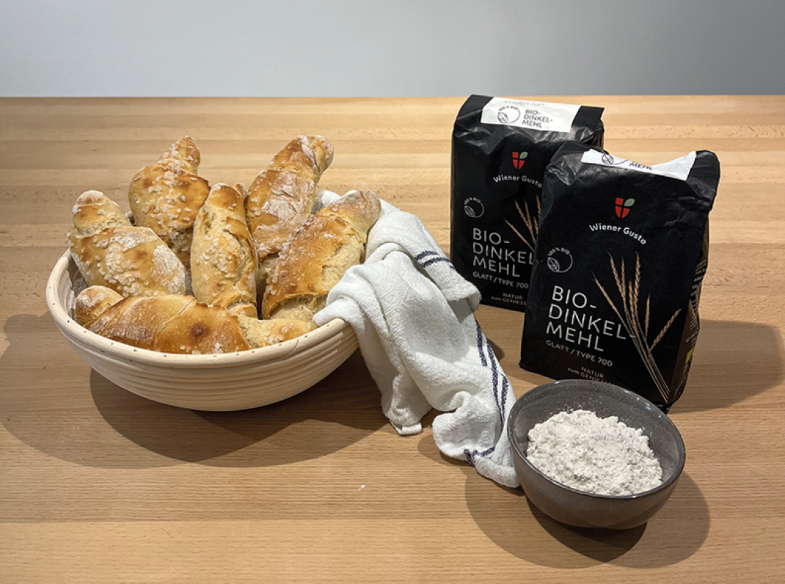
Municipal Department 49 – Vienna Forestry and Agriculture manages around 2,000 hectares of arable land and vineyards using organic methods, making it one of the largest organic operations in Austria. Since 2022, products such as flour, lentils, linseed oil and potatoes have been marketed directly to consumers under the Wiener Gusto brand. The aim is to raise awareness of regional organic products.
Potting soil made from compost from Vienna’s organic waste
Municipal Department 48 – Waste Management, Street Cleaning and Vehicle Fleet produces high-quality, peat-free soil for all types of planting in homes and gardens using organic waste, bark humus and wood fibres. For each 40-litre bag of soil, the use of compost made from Vienna’s organic waste, together with other additives such as bark humus, can save up to 36 litres of peat.

Lever 14: Holistic food strategy at regional level
Sustainable, healthy and resource-saving nutrition is a key cross-cutting issue and affects many areas of policy and administration - from agriculture and health through to education. A holistic food strategy brings together ecological sustainability, public health, social justice and the responsible use of natural resources.
In line with the Milan Urban Food Policy Pact, the City of Vienna pursues an integrated and established administrative practice that creates policy frameworks on which all relevant areas - such as agricultural production, public health and the education system - can build.
Our activities
- Integrated urban policy frameworks: Regional and local food policy, as well as urban implementation structures in line with the Vienna Food Action Plan Wien isst G.U.T. and the Milan Urban Food Policy Pact, are being developed in cooperation with agriculture, academia, NGOs and people across the entire region.
- Low-threshold access: Access to sustainably produced and healthy food, particularly for socially disadvantaged groups, is being improved (for example, in communal catering).
- Participation in implementation: A wide range of stakeholder groups (including agriculture, academia, NGOs and people in Vienna) across the entire metropolitan region are actively involved, and local initiatives for a resilient and fair food system in Vienna are supported.
- Sustainable food logistics and distribution: Sustainable food transport, including transhipment hubs and cooling facilities for supply from the surrounding region, is being supported (see also Chapter 3).
- Innovative products: With a focus on “Food Innovation”, the Vienna Business Agency supports the development of innovative products and business models for a healthy, sustainable and resilient food system (see also Chapter 3).
Lever 15: Halting food waste
Many initiatives are committed to preventing food waste. They are being continuously further developed and expanded to better address the needs of specific target groups, for example through interactive formats. The City of Vienna supports initiatives such as United Against Waste and projects run by Tafel Österreich and is a cooperation partner of the federal initiative Lebensmittel sind kostbar! (“Food is precious!”).
Projects and measures are primarily implemented and promoted by Municipal Department 22 – Environmental Protection, through waste-prevention advice in schools and kindergartens and through the initiative Natürlich weniger Mist (“Naturally Less Waste”).
Our activities
- Storage and refrigeration infrastructure: Social institutions will continue to be supported in expanding storage and refrigeration infrastructure for food donations, enabling more efficient redistribution (for example, through advice and funding). In addition, the City of Vienna supports efforts to simplify the safe, charitable redistribution of food.
- Information and knowledge initiative on minimum durability dates: The City of Vienna advocates at federal level for the implementation of an Austria-wide campaign to raise awareness of the meaning of the minimum durability date, where appropriate involving the retail sector.
- Events: Measures to prevent food waste (for example, the promotion of GenussBoxen, ÖkoEvent criteria and advisory services provided by OekoBusiness Wien – ecoBusiness Plan Vienna) are being further developed.
- Redistribution of food: The City of Vienna is examining how the redistribution of surplus food to social institutions could be implemented in the staff restaurants of the Vienna Health Association (WiGeV), in Vienna’s schools or in companies contracted by the City of Vienna, for example, via the Wiener Lebensmitteldrehscheibe (Vienna Food Exchange Platform) and the Tafel-Drehscheibe (Tafel food exchange platform).
Lever 16: Resource-saving communal catering and gastronomy
The City of Vienna manages the largest food procurement volume in the entire metropolitan region: around 120,000 meals per day, or 44 tonnes of food per year, are provided in schools, kindergartens, hospitals, care homes, residential homes for older people and additional canteens. The gradual expansion of a regional, seasonal, plant-based diet based on certified organic production is a key lever for climate action and saving resources.
Since 1998, a mandatory organic quota has applied in municipal communal catering and is enshrined in the ÖkoKauf Wien procurement programme (see also Chapter 3). At present, this quota amounts to 30 per cent overall, 50 per cent (voluntary) in schools and 60 per cent in municipal kindergartens. The federal government’s target of an organic quota of 55 per cent by 2030 has already been adopted by the City of Vienna as its own objective.
Comparable target requirements in private communal catering and the general gastronomy sector can, in the absence of a legal basis, only be achieved on a voluntary basis and are, for example, well received through the initiative Natürlich gut Essen (“Eating Well – Naturally”).
Our activities in public communal catering
- Organic quota: Existing instruments for implementing measures aimed at achieving an organic quota of 55 per cent by 2030 are being continuously evaluated and strengthened.
- Plant-based nutrition: The share of plant-based meals in communal catering is being increased, taking into account the needs of different target groups (for example, in care and support facilities, kindergartens and schools), including through “Veggie Days”.
- Benchmarking systems: The Moneytor programme run by United Against Waste enables operators of large-scale kitchens to monitor their food waste on an ongoing basis and to easily identify the greatest savings potential. Further development in the form of footprint calculators is being examined.
Our activities in private gastronomy and communal catering
- Requirements: Criteria for sustainable and resource-saving procurement, such as those developed under ÖkoKauf Wien and naBe (nachhaltige Beschaffung des Bundes – the federal sustainable procurement programme), are being made available in a low-threshold manner for private gastronomy businesses and communal catering facilities.
- Advice and voluntary commitments: Advisory and information programmes as well as certification and award schemes - including the Environmental Label for Gastronomy and Accommodation Establishments and OekoBusiness Wien – ecoBusiness Plan Vienna - are being continued.
Lever 17: Vienna produces regionally and organically
The City of Vienna manages a total of 2,200 hectares of agricultural land that it owns and operates one of the largest 100-per-cent organic farming operations in Austria. Nevertheless, Vienna’s food supply depends on the surrounding regions as well as on numerous national and international production factors. It is therefore essential to safeguard agricultural land and to progressively expand regional cooperation for the provision of high-quality, regionally produced organic food. In this way, regional cycles are closed and the food supply is secured at a consistently high level over the long term.
Our activities
- Organic farming: The expansion of the organic share of agricultural land within the city area - from its current level of more than one third to 100 per cent - is being pursued through cooperation with existing farms and the Chamber of Agriculture Vienna
- Locally producing and organic businesses: Regulatory frameworks, funding instruments and public procurement processes (for example, market regulations and market space at the Naschmarkt) specifically support local businesses in production and gastronomy.
- Own-brand Wiener Gusto: Further product offerings, as well as the development and provision of the necessary marketing instruments, are being examined on the basis of potential assessments, market analyses and cost–benefit studies, serving as a specification of the study Food Standort Wien – study on Vienna as a food business location (https://www.wien.gv.at/umweltschutz/oekokauf/pdf/lebensmittel-bio.pdf, accessed on 5 May 2025).
- Alternative forms of urban food production: Urban agriculture (“urban farming”), novel foods (“new food systems”, for example, protein substitutes) and comparable systems such as community-supported agriculture, cooperative harvest fields and community gardens are being strengthened through potential assessments and the establishment of cooperation.
- Targeted development of regional cooperation: To strengthen regional self-sufficiency, cooperation on food production with Vienna’s surrounding region is being developed in coordination with the Province of Lower Austria (see also Chapter 3).
Lever 18: Biogenic waste in the cycle
Closing biological cycles is a core component of the circular economy and saves both resources and costs. Already today, the biogenic waste collected separately in Vienna is either used for composting or sent to the Simmering biogas plant. Biogenic waste is thus processed into compost or biogas, which is then used as an energy carrier in various applications.
A particular type of resource is found every day in our wastewater: in addition to numerous pollutants, it also contains phosphorus. Phosphorus is an essential and non-substitutable nutrient and has been classified as a critical raw material since 2014, as the EU is dependent on imports. Moreover, phosphorus is indispensable for plant growth and is used as a fertiliser and for building humus.
Our activities
- Assessment of collection potential: The remaining potential for collecting biogenic waste from households is being evaluated, with a focus on locations with particularly high potential.
- Vienna biogas plant: Based on the findings of the strategic environmental assessment of the Vienna Waste Management Plan, the capacity of Vienna’s biogas plant will be doubled.
- Phosphorus recovery facility: The City of Vienna is examining the construction of a facility to recover phosphorus from sewage sludge in Vienna. Until such a facility is operational, the transfer of portions of sewage sludge ash to cooperation partners for fertiliser production is to be pursued.
- Separate collection: Efforts to reduce the proportion of biogenic waste in residual waste - particularly from businesses in the retail, gastronomy and tourism sectors - and to increase the amount of biowaste available for anaerobic digestion or composting are being intensified.
Saving resources in Vienna’s health, care and social sectors
A wide range of facilities provide people in Vienna with services in the areas of health, care and social support on a daily basis. These services also require significant resources. For this reason, the City of Vienna places particular emphasis on this area: the health and care sector is of major social importance and, not least for this reason, calls for careful and responsible engagement with the issue of saving resources. In particular, medical products as well as non-clinical products related to catering and nutrition are key goods in these sectors. Buildings are addressed separately in the final chapter.
In its current sustainability and climate action guidelines, the Vienna Health Network (WiGeV) also places a clear focus on the circular economy. One of the declared objectives within these guidelines is to optimise resource consumption.
Hospital operators with sites in Vienna, including the Vinzenz Group, the Brothers Hospitallers of St John of God, the Elisabethinen and Premiqamed, have established certified environmental management systems that address saving resources and waste reduction.
BEST PRACTICE
Anaesthetic Gas Recycling
In clinics operated by the Vienna Health Network, the recycling of anaesthetic gases using activated carbon filters has been implemented. As anaesthetic gases remain in the atmosphere for extremely long periods, this represents a significant step towards a sustainable healthcare system.

Lever 19: Process and workflow optimisation and digitalization in the health and care sectors
The further development of processes, requirements, workflows, activities and structures in line with circular principles optimises ongoing operations and reduces resource demand in the health and care sector in accordance with the 10-R principles of the circular economy (see also Chapter 3). This enables greater efficiency and cost savings to be achieved.
The activities under this lever are based on the Austrian strategy Klimaneutrales Gesundheitswesen (“Climate-Neutral Health Sector”). This federal strategy proposes, among other things, incentive schemes and statutory obligations for healthcare and care institutions (see also Chapter 4).
Our activities
- Pharmaceutical exchange: Pharmaceutical exchange schemes for the internal redistribution of medicines will in future be organised across departments and further expanded.
- Duplicate prescriptions of medicines: Measures are being implemented to prevent duplicate prescriptions arising from inpatient care, outpatient care and the primary care system.
- Digitalisation: Optimisation potential created by ongoing digitalisation is being harnessed. Possible digital tools range from paper-free, efficient workflows and services to digitally supported treatment methods (such as telemedicine, “Best Point of Service”, preventive medicine and therapeutic approaches; see also Chapter 3). These tools are being developed while safeguarding quality of care, equality of opportunity and the social value base.
- Medical products: In addition to environmentally responsible procurement, the consumption of medical products is to be reduced while safeguarding quality of care and hygiene standards. Reusable products, repair, return systems and reuse are to be actively promoted. This applies not only to medical products but also to cleaning and disinfecting agents, laundry and textiles, as well as operating supplies and equipment.
Lever 20: Waste separation and recovery in the health and care sectors
The waste generated by health and care facilities contains many valuable materials that have not yet been utilised. There is therefore a need to further develop waste collection and processing along the recovery and disposal chains (see also Chapter 4). Instruments, guidelines and standards for the preparation of waste management concepts with clear specifications on waste separation and waste logistics already exist. These can be used in a targeted manner to identify potential for reuse and further use, recovery and proper disposal.
The strategy Klimaneutrales Gesundheitswesen (“Climate-Neutral Health Sector”) includes proposals for the general improvement of waste management, such as measures to optimise packaging sizes for medicinal products.
The guidelines of the Vienna Health Network (WiGeV) also define intelligent waste and delivery logistics as an important measure.
Our activities
- Circular waste management: All facilities in the health and care sector will prepare a waste management concept or a waste management plan. Existing instruments can be used for this purpose, including the guideline on waste separation issued by the Working Group on Hygiene in Healthcare Facilities of the Municipal Health Service (MA 15).
- Recycling potential within the Vienna Health Network: A standardised assessment and documentation of the recycling potential of valuable materials will be carried out.
- Recovery and disposal strategies: Within the framework of pilot applications and test projects, and in close cooperation with companies in the health sector (research and development, services, operations and production), disposal and recovery strategies will be further developed.
Lever 21: Vienna-wide circular economy programmes in the health and care sectors
The Vienna Health Network (WiGeV) plays a pioneering role in the transition towards a resource-saving health and care service provider. To achieve the greatest possible impact, as many organisations and companies in the health and care sector as possible must embark on the path towards the circular economy.
Effective implementation requires close cooperation between all actors in the health and care sector, in particular with the federal government, Gesundheit Österreich GmbH (GÖG – Austrian Public Health Institute) and the Fonds Gesundes Österreich (FGÖ – Austrian Health Promotion Fund).
Our activities
- Sector-wide benchmarking: The introduction of comparative monitoring to evaluate progress in reducing energy and resource consumption is being examined and further developed.
- Environmental management systems: The establishment and implementation of environmental management systems in all health and care facilities are supported. Information and data on instruments and experiences from city-run facilities are shared.
- Funding provisions and contractual frameworks: Saving resources and the circular economy are taken into account in funding provisions and contractual frameworks, for example those of the Vienna Health Network and comparable organisations.
- Advisory programme Klimafreundliche Gesundheitseinrichtungen (“Climate-Friendly Healthcare Facilities”): The GÖG initiative is used to support the institutional anchoring and continuous implementation of improvement measures.